Penczykowski Lab's Plant Disease team featured in Philosophical Transactions of the Royal Society B

The delicate leaves of early summer lettuce have turned bitter, but the fruity ozone of tomatoes is bursting, peppers are popping, pompons of zinnias are fluffing, and towering sunflowers lean over to greet us. Summer gardening is in full swing. With so many minds on plants, it’s a good time to turn our attention to the challenges plants face. We may be worried about the trail of destructive fungus left by cucumber beetles, but disease ecologists from the Penczykowski Lab are concerned with powdery mildew on weeds, Plantago to be specific.
For the past several years, Rachel Penczykowski has been leading collaborative literature review and critical discussions with undergraduate students in her class BIOL 4195 Disease Ecology. The class, held during spring semester, covers the ecology and evolution of disease, including through discussion of research articles spanning observational and experimental studies, metagenomic analyses, and theoretical research on host-parasite interactions. Penczykowski specifically enjoys teaching students how to write a literature review, looking at gaps in broader research that haven’t been studied.
The class’s literature review and synthesis work continued and grew into a larger project, recently featured in a special issue of Philosophical Transactions of the Royal Society B. The overall theme of Volume 381, Issue 1951 is Wild Plant Pathosystems, “The papers in this theme issue show how studies of wild plant–pathogen systems are expanding scientific knowledge in critical areas of disease ecology and evolution, including responses to environmental change and interactions between natural and human-managed systems. They cover a wide range of subjects and provide knowledge useful in developing more sustainable plant health management strategies,” (Volume 381 Issue 1951 | Philosophical Transactions of the Royal Society B | The Royal Society).
Disease became a hot topic during the worldwide COVID-19 pandemic in 2020. In conducting broad reviews of existing research articles, Penczykowski noticed there was a research gap on urbanization’s effect on plant disease, for both wild and cultivated plants. She shifted her lab’s research and her classroom instruction to this topic, starting with experiments in her own driveway while isolated at home. Research progressed with the return to work and in-person class several months later and by 2023, Postdoctoral Researcher Kaylee Arnold took the lead on the plant disease project. Some undergraduate students volunteered to participate in continuing the research. Together, they pulled up nearly 7000 papers for a systematic literature review. The team screened titles and abstracts to see which papers were relevant. Every paper was screened by two people on the team over two to three years. Out of 6427 papers, 453 full text articles were chosen and reviewed. The team performed a qualitative synthesis of 54 studies, then landed on a meta-analysis of 14 papers.
Their takeaways highlighted a disciplinary gap (see infographic below). Most of the existing research covered tree hosts for insects/fungal pathogens, so the meta-analysis was performed just on those studies. When she analyzed the data from those papers in the meta-analysis, Arnold found that there was no overall difference between urban and non-urban trees in terms of the abundance of all pests and pathogens. However, she found a significant effect of the type of pest/pathogen, where the insect pests tended to be less abundant on urban trees and fungal pathogens tended to be more abundant on urban trees.
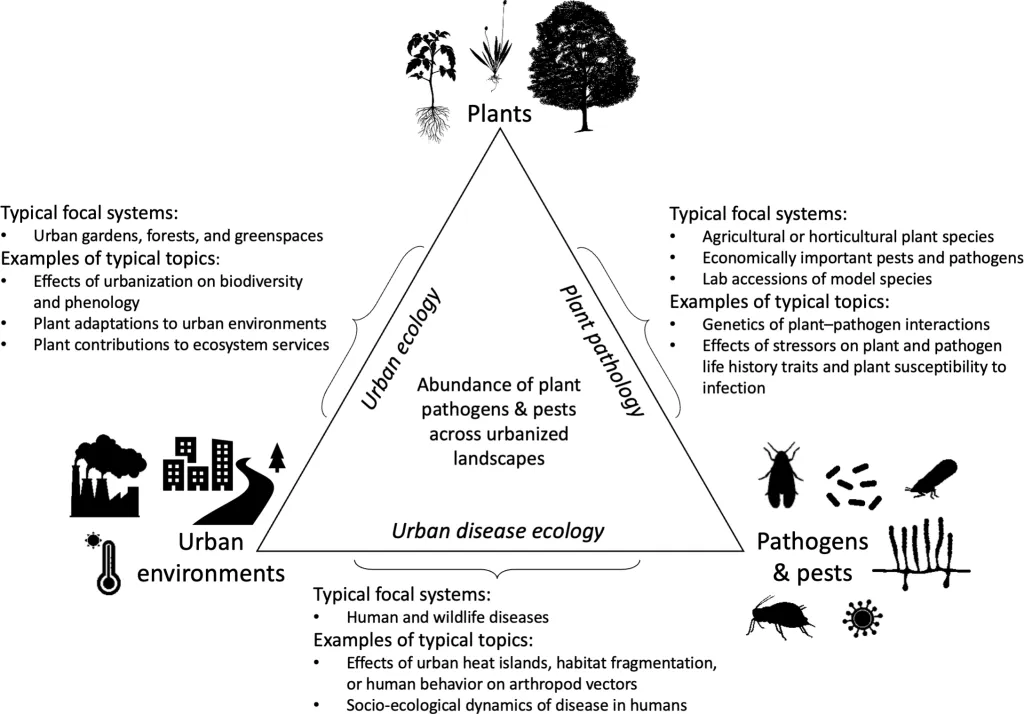
Factors that change from rural to urban areas that might influence plant diseases include urban heat islands, humidity, fungal pathogen movement, and watering by humans. The team notes that the urban heat island effect could mean more disease in cities for pathogens that are warm-adapted, but not for pathogens that are adapted to a cooler temperature. The resulting paper’s abstract outlines their findings and their importance: “Understanding how urbanization affects plant interactions with pathogens and herbivores is important for clarifying how changes in land use, climate and biodiversity affect ecological and evolutionary processes, and for managing urban plants to maximize ecosystem services,” (Read More).
Last spring’s class developed mathematical models of plant diseases spreading across theoretical cities. By simulating those models, they made predictions for how prevalence of disease should change with urbanization, depending on the baseline climate for the region, the magnitude of the urban heat island effect, and the spatial distribution of host plant populations across the theoretical landscape.
Both Arnold and Penczykowski express excitement about studying topics that are understudied, teaching undergrads how to conduct research, and having opportunities to work with kids in local elementary schools and urban gardens, noting that education at an early age has an impact. They saw that the lessons they taught kindergarten students stuck with the first graders the following year. Read this article to see how elementary students retained lessons learned early on.
This fall, Penczykowski will be on sabbatical, further developing the mathematical modeling work to make predictions for urban plant disease patterns in cities around the world. Because Plantago and powdery mildews can be found worldwide, she is setting up a globally distributed research network in which collaborating scientists will perform observational surveys to test those predictions. To kick-start that global effort, Penczykowski is conducting observational surveys in European cities including Helsinki, Finland. Arnold will continue the disease ecology work of the lab here in St. Louis, using field results as a case study for a larger body of work.
Learn more about the Penczykowski Lab here.