The Living Earth Collaborative has spent the past several years bringing together researchers, conservationists, policymakers, and community organizations around a shared goal: building a greener, more sustainable St. Louis. At this year’s Making St. Louis the Nature City of the 21st Century Symposium, WashU students joined that work.
Three student teams presented design proposals developed with input from LEC’s regional working groups, which focus on urban biodiversity and access to nature, urban heat and trees, and water. The students were challenged to consider how trees and green space could address environmental needs while responding to the realities of urban neighborhoods.

Their proposals took three distinct approaches. One team developed an online calculator that helps users identify tree species suited to a neighborhood based on local environmental conditions. Another explored ways to connect greenways with St. Louis’ musical history. A third examined how a city block could be redesigned to incorporate more trees and green space. Seth Denizen, an assistant professor at the Sam Fox School of Design & Visual Arts, organized the challenge and helped to judge the entries.

“The design students nailed it — blending science and design to reimagine how trees can bring more nature into our cities, for the benefit of both people and the environment,” said Jonathan Losos, the William H. Danforth Distinguished University Professor and co-director of the Living Earth Collaborative. “What impressed me most wasn't just the creativity of the three groups, but how differently each one approached the problem.”
The projects also reflected questions that have become especially urgent in St. Louis. The May 2025 tornado toppled or irreparably damaged more than 3,000 trees in Forest Park alone and caused extensive damage elsewhere in the city, underscoring the complexity of maintaining an urban forest that provides shade, biodiversity and other benefits while remaining resilient to severe weather.
Anjali Raman, an architecture and environmental studies student and former Cairn Fellow with the Gephardt Institute for Civic and Community Engagement, worked with LEC’s urban heat and trees group, which allowed her team to access data that helped ground their proposal in the needs of St. Louis neighborhoods.
"The East-West Gateway Council of Governments gave us GIS datasets that are not readily publicly available," Raman said. "It’s basically data on types of surfaces and land surface temperature. We combined those with social factors to create a heat vulnerability index, which directly shows you that the poorest areas of the city are most susceptible to heat because of the lack of green spaces."
Raman and her teammates used that information to reimagine a section of North Grand Boulevard near Fairground Park, proposing additional green space and tree plantings alongside established trees in the area.
"So many of my classmates are interested in urban design," Raman said. "But there are so few opportunities to actually do that. There can be so many components, for example: social planning, considering racial equity, and environmental impact. This is one of the first opportunities I've seen as an undergraduate student to really get a taste of urban design."
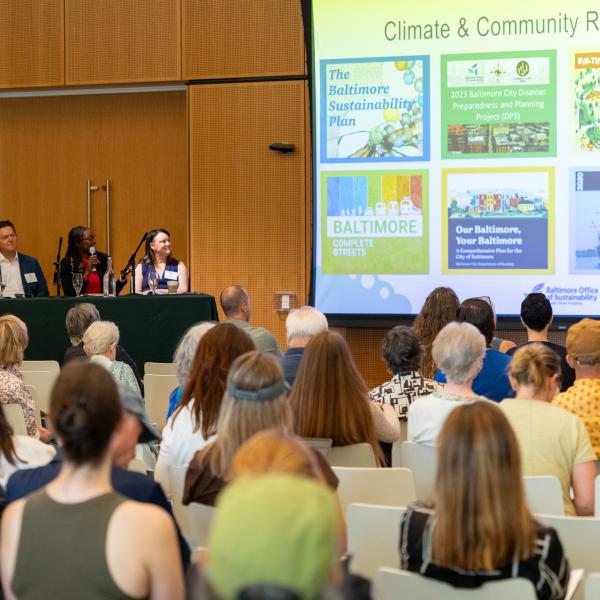
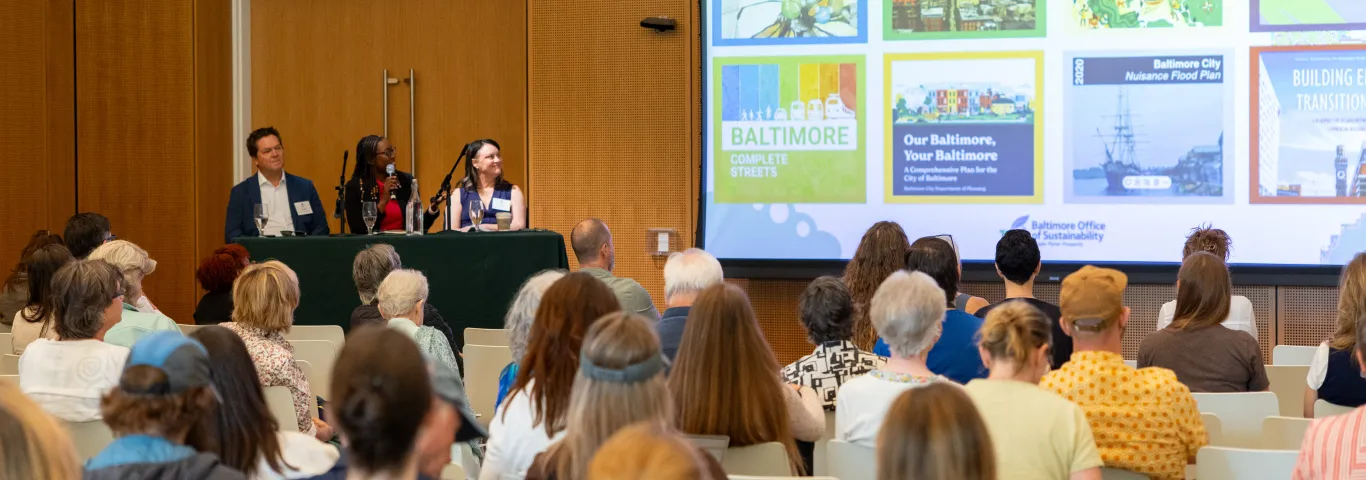
The student presentations were part of a broader symposium that brought together environmental experts from across St. Louis and beyond. The event included updates on regional biodiversity efforts, perspectives from representatives of Baltimore, Austin and Washington on expanding urban green space, and a keynote address from environmental journalist Sam Bloch on the role of shade in reducing extreme heat.
For LEC, the student design challenge offered another way to connect the research, community expertise, and education at the heart of its mission. As the collaborative looks ahead, those connections offer a model for turning conversations about St. Louis’ environmental challenges into ideas that can be tested, refined, and put into practice.