Professor Jonathan Losos talks about his new course BIOL 4010 Biology of Mammals
The Biology of Mammals, a course uncovering both detailed mammalian phylogenetics and the intriguing habits of furry creatures, brings an exciting opportunity for undergraduate students to understand and marvel at the vast biodiversity of the mammal world. A perfect course for animal lovers and future zoologists alike, the course combines multiple aspects of interactive learning into a one-semester Biology elective.
Jonathan Losos, William H. Danforth Distinguished University Professor, is bringing the study of mammalogy to WashU’s Biology curriculum. He is a leading expert on the biodiversity of species and serves as the Co-Director of the Living Earth Collaborative. The collaborative is a partnership between WashU, Missouri Botanical Gardens and the St Louis Zoo; a research-focused consortium working to advance biodiversity education. It came about when “three leading institutions in the field of biodiversity, decided to join forces to make the whole greater than the sum of its parts,” elaborates Losos.
His fascination with the natural world began early in his childhood: having cats, caimans (relatives of alligators, only a bit smaller) and lizards as pets. His interest further developed while studying Biology during his undergraduate years at Harvard University. “The more I learned about biodiversity, the more fascinated I became,” said Losos. His interest then led him to pursue his doctoral degree in Zoology (specifically Herpetology) at University of California, Berkeley before moving to WashU first in 1992 and again in 2018.
In addition to teaching the Biology of Mammals, his research at WashU is focused on “how species evolve and adapt to their circumstances and measuring the capabilities of animals and their behavior, ecology and deeper phylogenetic components.” The course structure mirrors this framework to allow students to think critically about what they learn. It provides them with an overview of mammals and their diversity while studying how species form, evolve and survive in the natural world today. “I want to integrate all of these ideas that students may have learned in individual biology classes and apply them specifically to mammal species,” said Losos, “in the last century we have seen the disappearance of the “-ologies,” with increasing student interest, we are starting to see an inclusion of these courses routinely in academic curricula.”
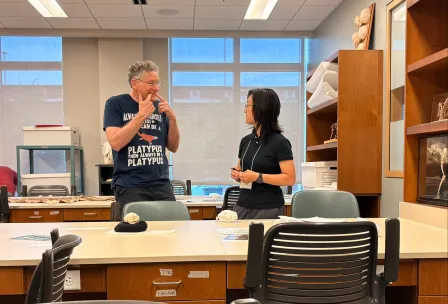
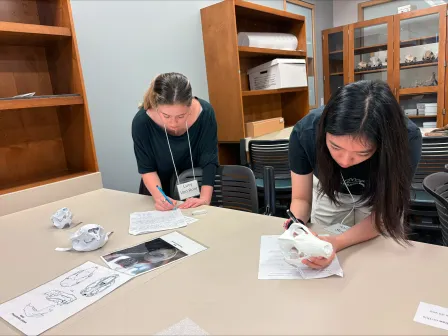
To achieve its goals, the course is structured into multiple modes of learning. There are two in-class lectures and one subsection per week. “The subsection will be a mini-lab focused on anatomy, which really highlights the differences (and similarities) between different mammals, for instance: a bat wing, a whale flipper and a human hand are all made from the same bones, just specialized for their functions!” The labs include specimens from the Biology Department’s Comparative Vertebrate Structure collection and the Anthropology Department’s Zooarchaeology Lab which serve as the basis of comparative anatomical study of the different mammal species.
Additionally, the course allows students to attend optional movie nights, starring The Life of Mammals by David Attenborough, accompanied by popcorn and classroom bonding! The course also includes a field trip to the St. Louis Zoo and the Endangered Wolf Center at Tyson to help students get familiar with the species they learn about in class. Losos urges students to use the course as an opportunity to learn more about the fascinating world they live in, stating: “No matter what students want to become, I want them to gain an appreciation for the diversity of mammal biology and equip them with enough facts so they can be the most interesting person at the party!” One can learn more about the course and Professor Losos’ research at: https://sites.wustl.edu/losos/.
Fun Fact: Professor Losos’ favorite animal is the duck-billed platypus!