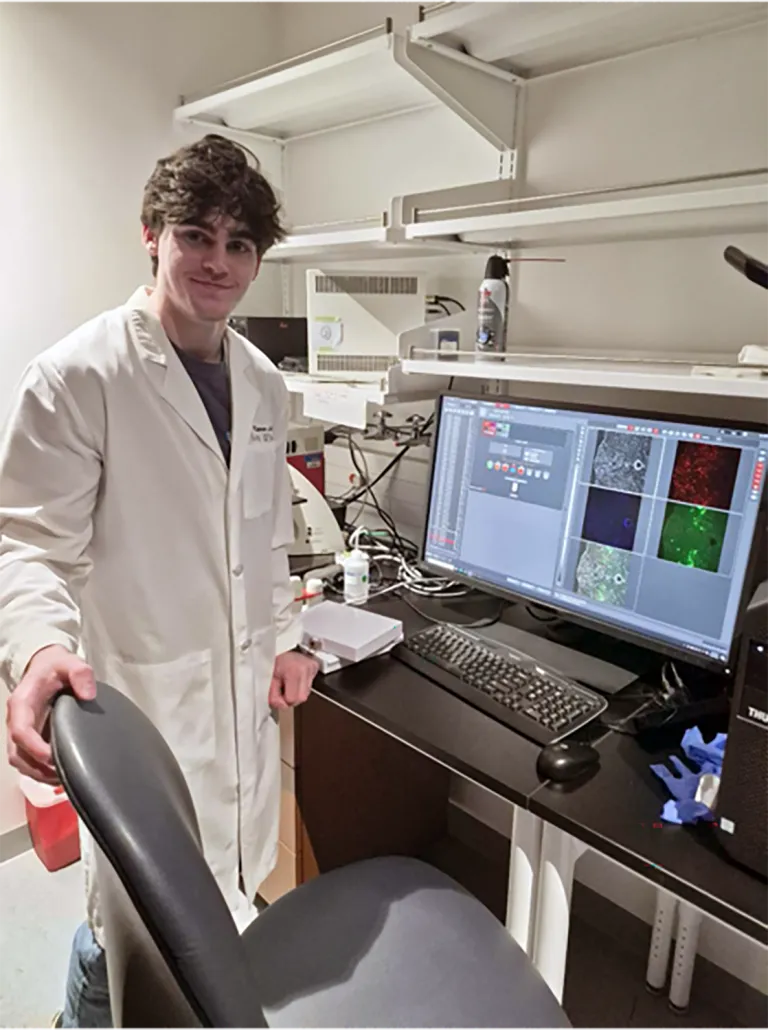
Undergrad student Rory O'Shea talks about brain research in the Kepecs Lab
I am a member of the Kepecs Lab, where I study how the brain computes the value of a reward and decides whether it's worth pursuing against competing motivations, such as defending against a perceived threat. My current project investigates an excitatory, canonically defensive frontal-to-midbrain projection, and its ability to track the cost-benefit ratio of reward pursuit. Using simultaneous dual-site fiber photometry, I specifically measure how glutamatergic activity in this pathway responds to independent variation in reward delay and reward size.
Adaptive behavior requires the brain to continuously transform internal states, goals, and environmental information into action. Among the most fundamental of these computations are those that guide motivated behavior: deciding what to pursue, how vigorously to pursue it, and when continued pursuit is no longer worth its cost. In the Kepecs Lab, we study how the brain makes these kinds of decisions.
Last year, I helped establish an excitatory corticosubcortical projection that's recruited when defense overrides reward pursuit (for instance, when a thirsty mouse drinking from a reservoir reflexively stops and flees after hearing a hawk screech). What's surprising is that this same circuit is also active when mice are simply chasing a reward, with nothing threatening around at all.
That observation is the starting point for my project: does this "defense circuit" actually do something broader, like tracking how valuable a reward is and whether it's still worth pursuing? To find out, I use simultaneous dual-site fiber photometry, a technique that lets us record calcium activity (a proxy for neural activity) while mice perform a task that independently varies reward size and delay to reward. By watching how the neural signal across this projection changes under these conditions, I hope to determine whether it encodes ongoing motivation, and whether it can predict the decision to stop pursuing a reward.
Along the way, I've learned to perform stereotaxic surgery to inject viruses that let us record from specific neurons, set up fiber photometry recordings, and take care of the mice themselves. I’ve also picked up the computational side of the work, using various coding platforms to write behavioral protocols, analyze data, and track mouse behavior during long experiments.
Research, I've learned, is a rabbit hole that runs deeper than I expected, where any question can be approached by any angle. In addition to learning new techniques, BIOL 2901 has helped me develop a love for the slow, iterative work of chasing down answers that nobody else has found.