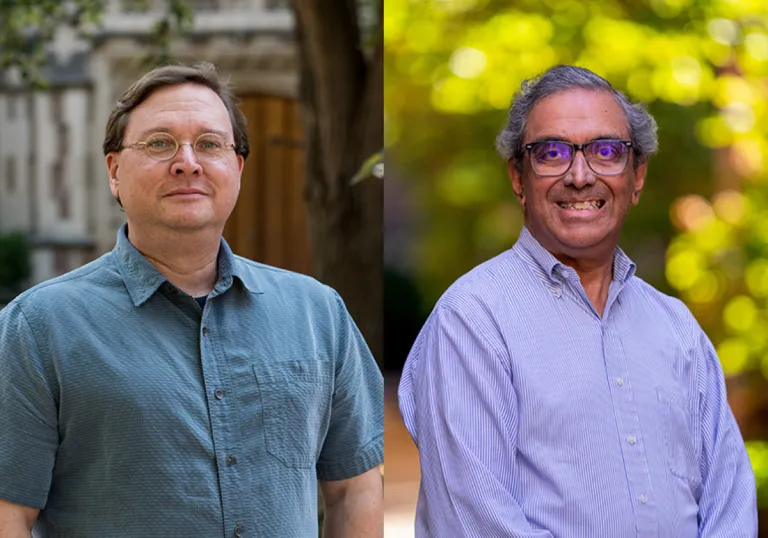
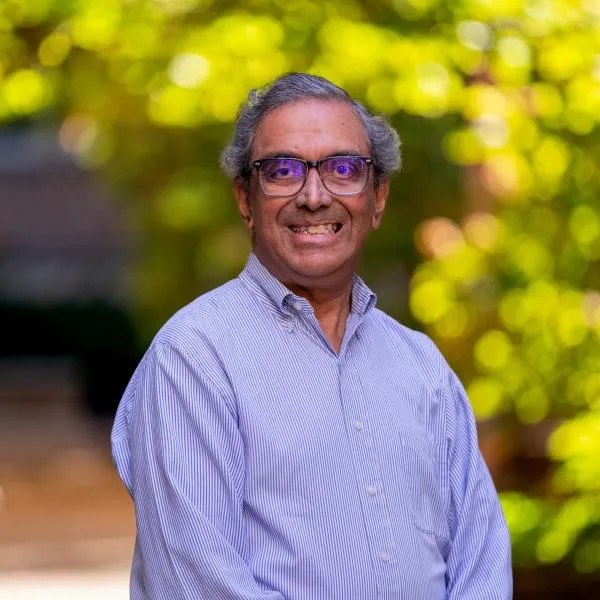
​Himadri Pakrasi

​Himadri Pakrasi

​Himadri Pakrasi

​George William and Irene Koechig Freiberg Professor
PhD, University of Missouri-Columbia
research interests:
  • Biochemistry
  • Photosynthesis
  • Nitrogen Fixation
  • Systems and Synthetic Biology
View All People

contact info:

mailing address:

  • Washington University
    CB 1137
    One Brookings Drive
    St. Louis, MO 63130-4899

​Professor Pakrasi conducts research in the broad areas of photosynthesis, systems biology and synthetic biology. He is deeply engaged in bridging research interests in physical and biological sciences.

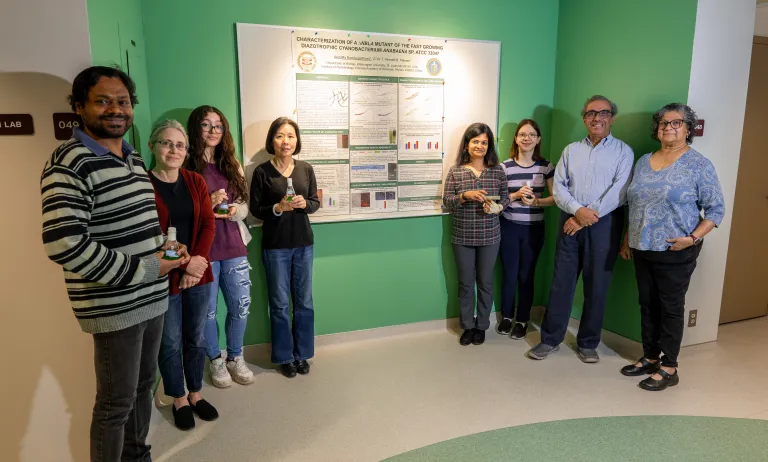
The Pakrasi Lab studies how cyanobacteria use solar energy to drive the chemistry of life.

We work across many disciplines and have projects that focus on determining how molecular machines that capture solar energy are assembled and maintained, how cyanobacteria respond to environmental changes at the systems level, and how to engineer new strains of cyanobacteria capable of channeling solar energy into biochemical production.

We are part of the Department of Biology at Washington University in St. Louis.

Dr. Pakrasi participates in the following graduate programs:

  • Biochemistry Doctoral Program in the Division of Biology and Biomedical Sciences
  • Plant and Microbial Biosciences Doctoral Program in the Division of Biology and Biomedical Sciences
  • Molecular Genetics and Genomics Program in the Division of Biology and Biomedical Sciences.

Awards

Fellow, American Association for the Advancement of Science
Fellow, American Academy of Microbiology
Wiley Fellow, Environmental Molecular Sciences Laboratory, Pacific Northwest National Laboratory
Alexander von Humboldt Fellow, Munich University, Germany
Distinguished Fellow, Biosciences Institute, Nagoya University, Japan
Lady Davis Visiting Professor, Hebrew University, Jerusalem, Israel
Courses Taught

BIOL 4834 Bioenergy

This course provides a comprehensive overview of biological energy capture and conversion, with emphasis on photosynthesis and the metabolic engineering of plants and microbes for bioenergy applications. Students will examine the flow of energy from sunlight into chemical bonds and explore how systems and synthetic biology approaches are used to redesign metabolic pathways for sustainable biomanufacturing. Topics include light reactions of photosynthesis, electron transport, carbon fixation, photorespiration, nitrogen fixation, metabolic integration, and engineering strategies for improving biological energy efficiency. The course integrates biochemical mechanisms with systems-level analysis and contemporary primary literature. (Biology Major Area A)

BIOL 3172 Biology for Climate Solutions

Human-induced climate change poses a pressing and pervasive threat to both human populations and to the biological world. The challenges of climate change are manifest and well known, increasing temperatures, greater variability of weather, sea level rise, leading to a host of consequences. Adapting to and mitigating climate change are essential activities for confronting the threats of climate change. The biological sciences offer great potential for addressing these threats. This course focus on efforts in biological research to adapt and to mitigate climate change. Topics will range across the biological sciences from microbial engineering and biotechnology to zoonotic diseases and one health, to ecosystem function and conservation of biodiversity. The course consists of lectures, discussion of assigned readings, and class projects. Class projects focus on science topics that addresses new approaches to climate adaptation and mitigation and constitute both of a written paper and class presentation. The goals of this class are: (1) to develop an understanding of basic climate science and the biological aspects of climate change, ( 2) to develop knowledge of the biological efforts towards adaption and mitigation for climate solutions.

Selected Publications

Complete publications list with article text

  1. Liu, D., Johnson, V. M. and Pakrasi, H. B. (2020) A reversibly induced CRISPRi system targeting Photosystem II in the cyanobacterium Synechocystis sp. PCC 6803. ACS Synth. Biol., 9: 1441-1449. doi: 10.1021/acssynbio.0c00106
     
  2. Lin, P.-C., Zhang, F. and Pakrasi, H. B. (2020) Sustainable production of sucrose in the fast-growing cyanobacterium Synechococcus elongatus UTEX 2973. Scientific Rep., 10: 390 doi: 10.1038/s41598-019-57319-5
     
  3. Garcia-Pichel, F., Zehr, J. P., Bhattacharya, D. and Pakrasi, H. B. (2020) What’s in a name? The case of Cyanobacteria. J. Phycol. 56: 1-5. doi:10.1111/jpy.12934
     
  4. Knoot, C. J., Biswas, S. and Pakrasi, H. B. (2020) Tunable repression of key photosynthetic processes using Cas12a CRISPR interference in the fast-growing cyanobacterium Synechococcus sp. UTEX 2973. ACS Synth. Biol. 9:132-143. doi: 10.1021/acssynbio.9b00417
     
  5. Weisz, D. A., Johnson, V. M., Niedzwiedzki, D. M., Shinn, M.K., Liu, H., Klitzke, C. F.  Gross, M. L., Blankenship, R. E., Lohman, T. M. and Pakrasi, H. B. (2019) A novel chlorophyll protein complex in the repair cycle of Photosystem II. Proc. Natl. Acad. Sci. USA, 116: 21907-21913; bioRxiv; doi:https://doi.org/10.1101/660712
     
  6. Hendry, J. I., Bandyopadhyay, A., Srinivasan, S., Pakrasi, H. B. and Maranas, C. D. (2019) Metabolic model guided strain design for cyanobacteria. Curr. Opinions in Biotechnol., 64:17-23  doi: 10.1016/j.copbio.2019.08.011.