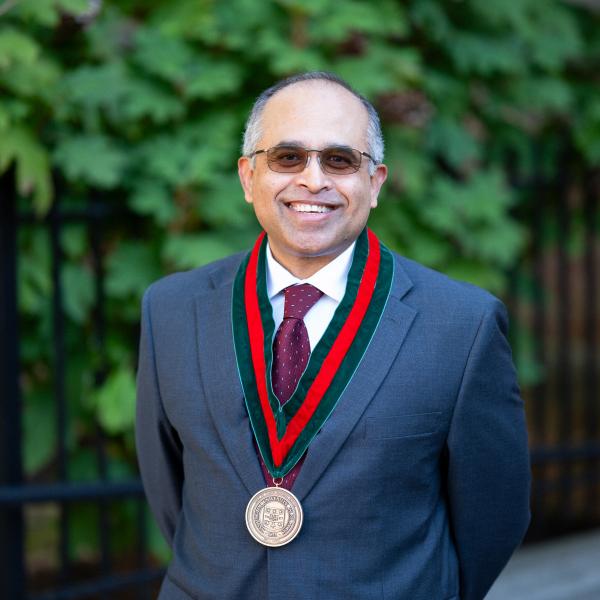
Jason Weber talks about the benefits of learning scientific writing early on

A familiar and respected figure among both undergraduate and medical students, Professor Jason Weber has been a member of the Washington University School of Medicine faculty for the past 25 years. A native of the St Louis region, Weber spent the early part of his life across the river in Illinois before pursuing his undergraduate studies at Bradley University and his PhD in Cell and Molecular Biology at Saint Louis University.
At WashU, The Weber Lab has evolved into a clinical and research lab specialized in cutting-edge research on breast, endometrial, lung and ovarian cancer. His lab consists of many graduate students, a few post-doctoral candidates and 4 or 5 undergraduate students. He commutes to Danforth Campus to teach undergraduate classes in cancer biology and biomedical writing.
Weber teaches BIOL 4584: Essentials of Biomedical Writing and Presenting each spring semester. It is a small class of 18 students, offering an approachable yet rigorous introduction to academic writing. The small class size provides students with plenty of one-on-one help and personalized critique. It allows for consistent feedback on writing, described as “an easy transition which develops into hardcore scientific writing,” by Weber.
The first third of the semester will use the required essay for graduate and medical school applications as a template. The focus will be on fostering skills involved in evidence-based writing, which includes persuading admissions committees of your merit as a potential interviewee. “It can be a hard journey to transition into academic writing from more descriptive writing. The essay serves as a good starting point to develop the art of written persuasion,” explains Weber
The second assignment for the course will be writing an Aims Page for a fictitious research grant. This will be the transition from persuasion to scientific communication. Grants are an essential part of scientific research, and developing these skills early can help students learn how write them compellingly:
The last assignment will include designing presentation slides for research and learning how to present in scientific conferences. The learning objective is to persuade audiences of the rigor of one’s research and reliability of the findings.
This 3-credit course meets on Wednesday evenings from 6 p.m. to 9 p.m. The class is open to all undergraduates and does not require any specific research background to enroll. The class is especially helpful for students applying to graduate or medical school. For some students, the course is their first dive into scientific writing and is usually an event split between pre-health and life sciences tracks. It is also extremely helpful for students writing an honors thesis in biology.
The class is offered in the spring semester of the academic year. “Although the class meets once a week, keeping a journal is an effective strategy for students to keep writing in their independent time,” urges Weber. Prose and editing heavy, the course offers a unique opportunity to get personalized feedback from a professor and plenty of room for improvement.