Undergraduate Serina Cao talks about her experience conducting research on goblet cells in the Newberry Lab
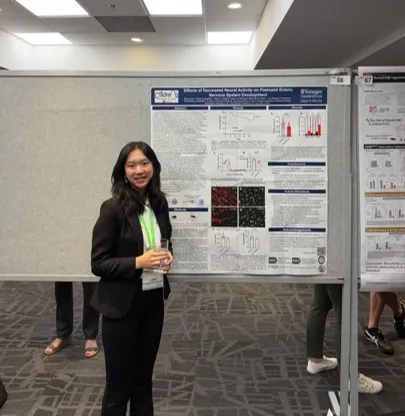
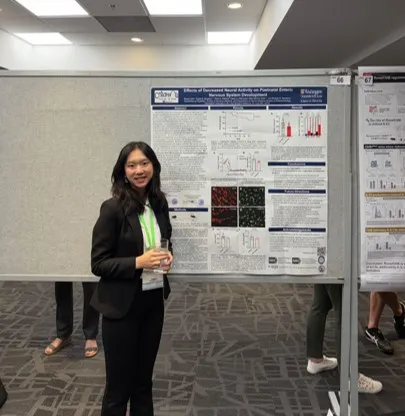
In the Newberry Lab, we study goblet cells and Goblet cell associated antigen passages (GAPs) and their roles in maintaining immune homeostasis and intestinal inflammation. We are interested in uncovering the mechanisms driving early-life development of the gut immune system and the enteric nervous system, with emphasis on the contribution of the gut microbiome. Under Drs. Rodney Newberry and Ellen Schill, my project in the lab focuses on understanding how reduced enteric neuronal signaling in early life (to mimic feeding intolerance and intestinal immaturity seen in premature neonates) affects postnatal enteric nervous system (ENS) development.
Clinically, intestinal dysmotility can pose a risk factor for gastrointestinal complications, such as late onset sepsis (LOS) and necrotizing enterocolitis (NEC). Under Dr. Ellen Schill, my work in the lab helped establish that when neonatal mice are treated with an agent that reduces enteric neuron signaling, it promotes bacterial translocation and death (similar to the LOS). This
suggest that promoting intestinal motility may reduce these complications in this vulnerable patient population. We utilize different mice models, immunofluorescence, cell culture, flow cytometry, microbiota analyses, RNA-seq, and other specialized techniques as part of our experimental design.
Alongside building strong basic science experiment techniques, such as cell culture and immunofluorescence, Bio 4954 provided an opportunity for me to grow as a more collaborative and resilient researcher, who takes initiative and responsibility. I am drawn to the creative, demanding and iterative nature of research, especially in the face of daily challenges in the lab. Most importantly, I wouldn’t be able to get to where I am today without the unconditional support of my mentors. Research is never straight forward or always filled with success, but my mentors are always celebrating the successes and helping me get back up through the failures. My mentors and my lab have continued to support and inspire me every day to understand the complex mechanisms and pathophysiology of these disorders to discover novel treatments that can improve patient’s quality of life while we continue to find a cure.