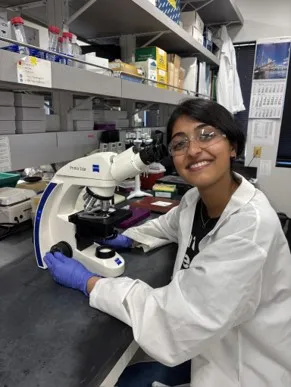
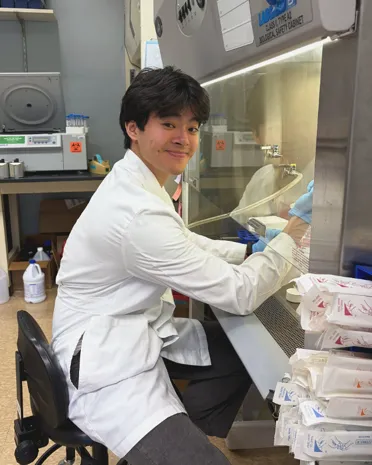
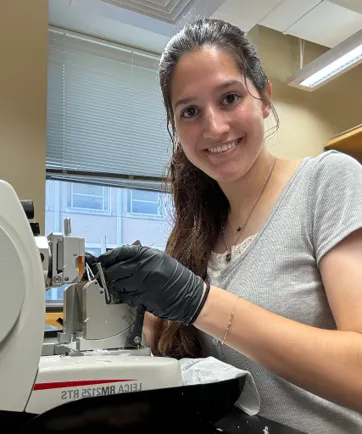
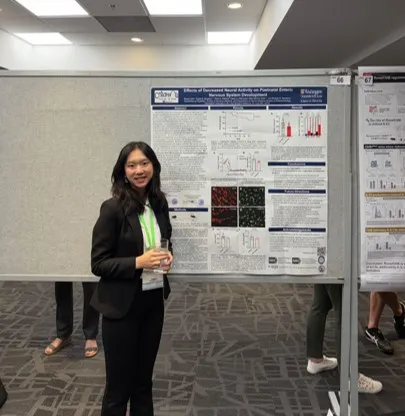
Undergraduate Vinisha Tripathi talks about her experience conducting research on lymphatic filariasis in the Fischer Lab
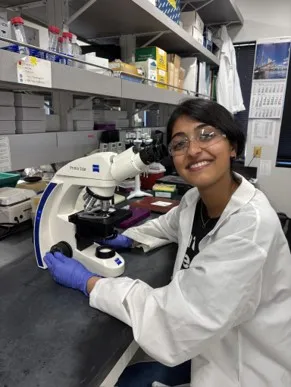
In the Fischer Lab, we focus on the eradication of lymphatic filariasis and onchocerciasis, working to study these major neglected tropical diseases (NTD). In particular, I study lymphatic filariasis (LF), an NTD caused primarily by infection with one of three closely related filarial parasites: Wuchereria bancrofti, Brugia malayi, or Brugia timori. Globally, 51 million people have this infection, which damages lymphatic vessels and results in lymphoedema and hydrocele.
I’ve spent the last year and a half as an undergraduate research assistant working on a xenomonitoring project to track the spread of LF in Cote d’ Ivoire. Xenomonitoring is a disease surveillance technique in which blood-feeding vectors are analyzed for the presence of pathogenic DNA. As an arm of the MDGH-Mox-3002 study, I analyze the presence of Wuchereria bancrofti in Anopheles gambiae mosquito populations. I study the populations before and after mass drug administration (MDA) to determine if MDA is having an impact on the reduction of W. bancrofti in mosquito populations, which would theoretically link to a decrease in human LF infection cases. I do this utilizing a workflow of mosquito pooling, Qiagen DNA extraction, qPCR, and PoolTest R software analysis. Using this methodology, I’ve become comfortable with sterile technique, computational methods, and literature review, skills that help throughout all processes of a research project’s development and execution.
Xenomonitoring is an important public health practice as it helps public health practitioners evaluate the effectiveness of their treatments and if it correlates with reduction of infection in all parts of the transmission cycle. Future implications of my research can determine distinct geographic or mosquito species-related factors that influence the spread of LF in Cote d’ Ivoire can inform preventive practices and diagnostic test development.
My time in the Fischer Lab has allowed me to develop critical thinking and troubleshooting workflows that encourage me to pursue scientific inquiry. My love for research has only grown from my time in this lab and my mentors have shown me how biology can be used to inform public health practice from the cellular level to the global level. I’m grateful for my lab’s mentorship and excited to continue researching NTDs, encouraging dialogue and discussion about how we can work to eliminate NTDS across the globe.