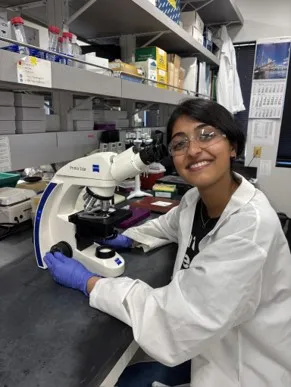
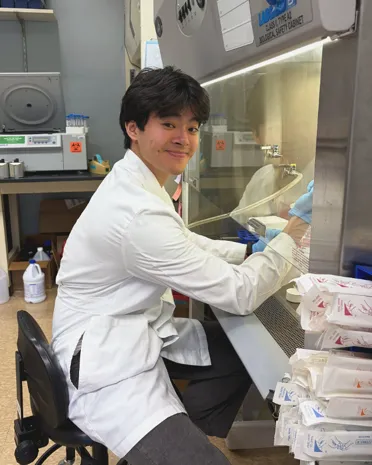
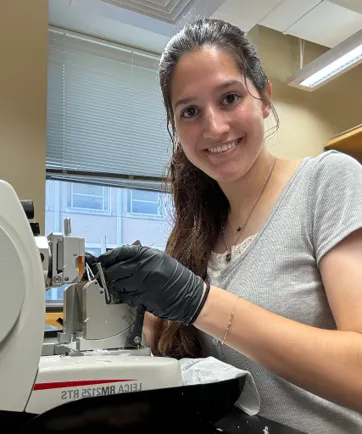
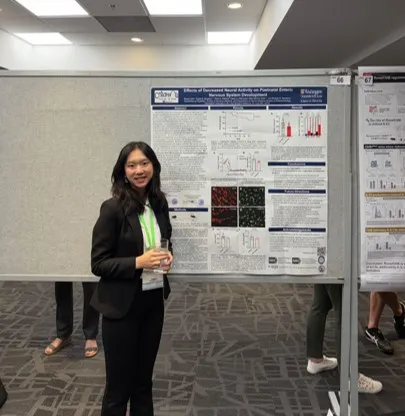
Undergraduate Sadie Navid talks about her experience conducting research on neurofibromatosis in the Gutmann Lab
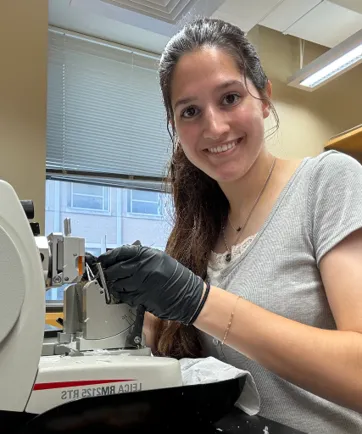
My research focuses on understanding how immune cells contribute to the growth of NF1-associated optic pathway gliomas (OPGs). Children with NF1 are at increased risk of developing these tumors and experiencing subsequent vision problems as well as cognitive complications. Previous work from the Gutmann Laboratory has shown that specific immune cells known as CD8+ T cells can support low-grade glioma growth through interactions with other cells in the tumor microenvironment. My project specifically investigates exhausted CD8+ T cells, which produce inflammatory cytokines that can promote tumor growth.’
To explore the mechanism by which these T cells enhance tumorigenesis, I work with tissue from genetically engineered Nf1-OPG mice that spontaneously develop OPGs. I measure optic nerve volumes to compare tumor size between treatment and control groups and use immunohistochemistry to analyze the tumor tissue. Studying this line of inquiry not only allows me to better understand the tumor microenvironment, but also prompts further investigation into immune-directed therapies for children with NF1-associated optic pathway gliomas.
My experience in the Gutmann Laboratory has sparked my career interest in oncology. I joined the lab while taking WashU’s two year Ampersand Program: The Hallmarks of Cancer and Patient Care. My research allowed me to apply classroom concepts to unanswered questions in the field of oncology. I am particularly fascinated by the ability of tumors to manipulate the immune system, transforming cells that normally defend the body into cells that bolster tumor growth. While immune dysregulation presents a significant challenge when considering treatment options, this transformation also presents an exciting opportunity for developing effective novel therapies. Because the immune system is extensively studied and increasingly targetable, understanding how tumors exploit immune pathways may reveal new ways to disrupt tumor growth. Exploring this line of research has strengthened my interest in oncology, and I am excited to continue pursuing this field throughout my academic journey at WashU and beyond.